
How to Choose Premium Flooring Brands Well

A new floor has to live with more than a mood board. It needs to cope with muddy shoes in the hallway, a busy family kitchen, chair legs in the dining room and the everyday wear that quickly exposes poor-quality materials. That is why premium flooring brands deserve closer attention when you are planning a renovation. The right range combines a convincing finish with dependable construction, clear product information and a specification suited to how you actually use the room.
A premium label alone is not a guarantee that one product will suit every property. The better question is whether the brand offers the right balance of design, durability, comfort and technical support for your project. For homeowners across Kent, seeing the products in person and discussing the practical detail before ordering can make that decision far more straightforward.
What premium flooring brands should offer
The difference between a premium product and a budget alternative is often more than surface appearance. At first glance, two wood-effect planks or two neutral carpets may look similar. Over time, however, the quality of the wear layer, backing, pile, edge detail and manufacturing consistency can affect how the floor feels, performs and continues to look.
Established brands usually invest heavily in product development. In luxury vinyl tile, that can mean more realistic embossing, better pattern variation, carefully scaled plank and tile formats, and collections designed to work across open-plan spaces. In carpet, it may mean a denser pile, more refined colour choices and fibres selected for stain resistance, softness or resilience.
There is also greater confidence in the supporting detail. A well-specified premium floor comes with clear guidance on suitability, cleaning, underfloor heating and warranty terms. That matters because even an excellent material can disappoint if it is used in the wrong environment or fitted over an unsuitable subfloor.
Start with the room, not the brand name
Brands are useful because they provide a benchmark for quality and style, but the room should lead the choice. A quiet bedroom has very different requirements from a kitchen-diner that opens onto the garden. Likewise, a rental property, a family home and a commercial reception area each call for their own balance of performance and budget.
Luxury vinyl tile is a particularly versatile option for kitchens, hallways, living spaces and bathrooms. Amtico and Invictus are recognised for design-led LVT collections that offer practical durability alongside the visual character of timber, stone and patterned flooring. Their ranges can work beautifully where you want a continuous look through several rooms without accepting the maintenance demands of natural wood or stone.
Carpet remains the natural choice where warmth, softness and acoustic comfort matter most. A premium carpet can give bedrooms, stairs and lounges a more considered finish, especially when the pile type and underlay have been selected properly. It is not simply a matter of choosing a colour. The density, twist, fibre composition and intended traffic level all influence how the carpet will perform.
Engineered wood offers genuine character and a tactile finish that many homeowners value in dining rooms, lounges and bedrooms. It needs a more measured approach around moisture, temperature changes and daily care, so it may not be the most forgiving choice for every kitchen or entrance hall. Laminate can be a sensible alternative when you want a timber look with a controlled budget, provided the product rating and installation details match the demands of the room.
Why installation is part of the premium choice
Buying a respected floor covering is only half the decision. The quality of the installation has a direct effect on its appearance, comfort and lifespan. LVT needs a suitably smooth, stable base to achieve the crisp finish people expect from it. Carpet relies on accurate measuring, careful fitting and appropriate underlay. Wood and laminate require allowance for movement, sound preparation and well-finished thresholds.
Subfloor preparation is easy to overlook when comparing product prices, but it is often where a long-lasting result is won or lost. Uneven areas, old adhesive residue, moisture concerns and damaged floorboards should be assessed before fitting begins. Covering over a problem may save money initially, yet it can lead to telegraphing lines in LVT, movement in boards or premature wear.
This is one reason an official partner and installer relationship has genuine value. It means the people advising on the collection understand how it should be prepared and fitted, rather than treating installation as an afterthought. At Modeco Interiors, product selection, home measuring and professional fitting are considered as one process, helping clients avoid the gap between a beautiful showroom sample and an underwhelming finished room.
Comparing premium LVT, carpet and wood
There is no universal winner between these flooring types. Each creates a different feel and solves a different problem.
LVT is often the strongest all-round choice for homes that need a hardwearing, easy-care floor with plenty of design flexibility. It can replicate natural materials convincingly while offering a warmer, quieter surface underfoot than ceramic tile. It is particularly effective for large kitchen-diners and connected ground floors, where consistent colour and format help the space feel more cohesive.
Premium carpet brings softness that hard flooring cannot replicate. It can also reduce footfall noise, making it especially appealing upstairs or in rooms where relaxation is the priority. The trade-off is that it needs thoughtful selection in homes with pets, young children or high levels of outdoor traffic. A durable, stain-resistant option can address much of this, but a pale deep pile may still be better reserved for lower-traffic rooms.
Wood has depth, variation and a sense of permanence, but it asks more from the homeowner. Natural marks and tonal changes are part of its appeal, not faults to be eliminated. If you prefer a perfectly uniform look and minimal upkeep, LVT may be the more practical route. If the individuality of real timber is central to your design, engineered wood can be well worth the additional care.
Look beyond the sample board
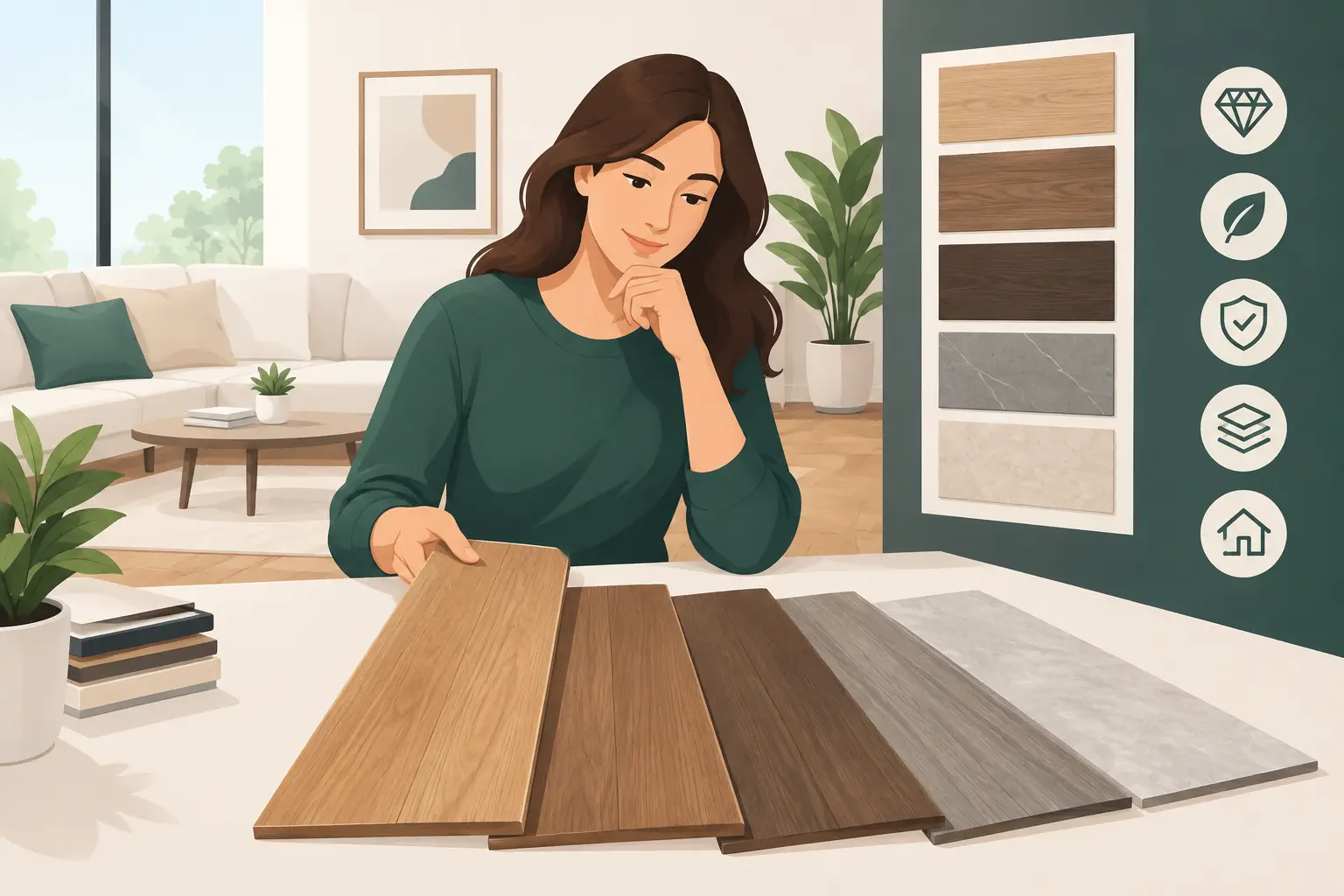
A showroom sample is essential, but it should begin the conversation rather than end it. Ask to see a larger board or several planks together, especially for wood and LVT. Pattern repeat, plank length and tonal variation become much easier to judge at scale. Take account of natural light too, as a floor that appears warm in a showroom can look cooler in a north-facing room.
It is also worth considering transitions between rooms. A bold patterned LVT in a hallway may look striking beside a calmer wood-effect design in the kitchen, but the join should feel intentional. In an open-plan area, a single collection or closely coordinated tone often gives the most polished result.
Budget should include the full scope of work: materials, underlay or adhesive, subfloor preparation, fitting, trims and any necessary uplift of existing flooring. Comparing only the price per square metre can create a false economy. A clear, personalised quotation makes it easier to see what is included and decide where spending more will genuinely improve the result.
Questions worth asking before you buy
Before committing to a floor, ask how it will respond to the realities of your home. Is it suitable for underfloor heating? What cleaning routine does it need? Is the product designed for heavy domestic use, or would a more durable specification be wiser? If you are choosing LVT, ask what subfloor preparation is likely to be required after a home measure.
For carpet, ask about the fibre, pile construction and recommended underlay rather than judging on softness alone. For wood, clarify the fitting method, finish and how the floor should be maintained. Good advice should be specific to your rooms, not a generic sales pitch.
The best flooring choice is the one you will still be happy with after years of ordinary life have taken place on it. Visit a showroom, compare finishes under proper light and arrange a professional measure before making the final call. A floor chosen with care will feel less like a purchase and more like the foundation of a home that works beautifully every day.


Comments